
Women at work
curated by Molly Goulding and the Cecile Elstein Studio team - April 2026
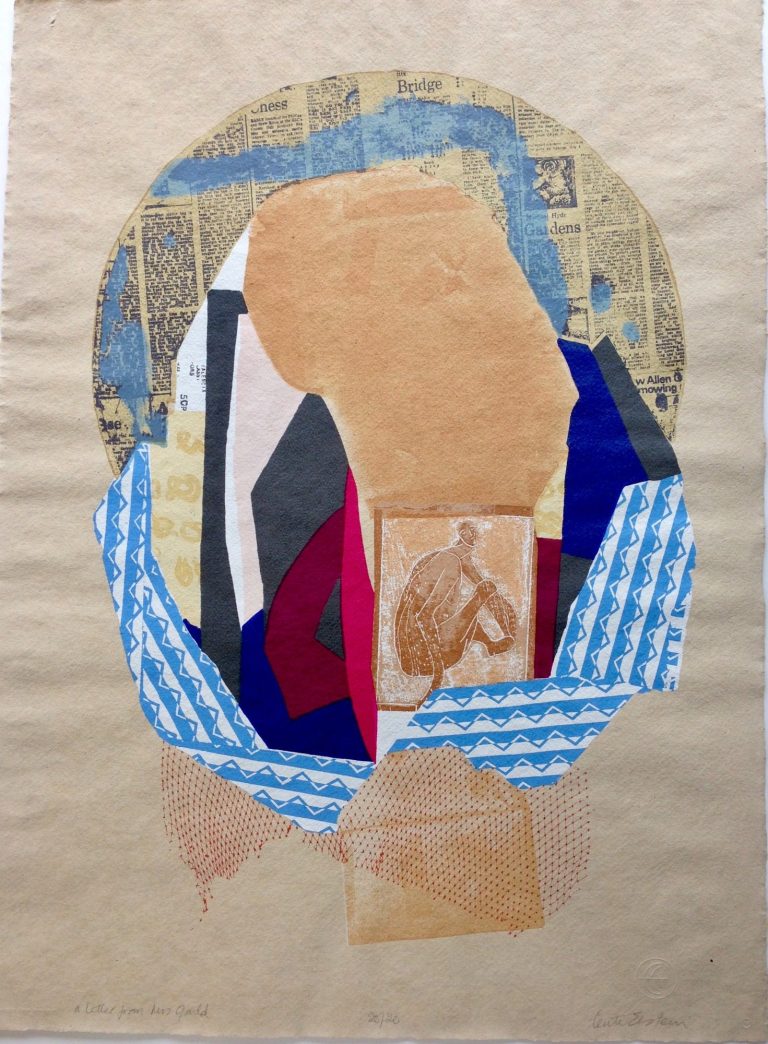
1981
A letter from Mrs Gould
Cecile Elstein’s screenprint, A Letter from Mrs. Gould, is currently on display at The University of Salford's New Adelphi Exhibition Gallery. The exhibition, titled City of Making, honours Salford’s industrial heritage and the contemporary creatives influencing the area since Salford was granted city status 100 years ago.
A Letter from Mrs. Gould was created in 1981 at the Manchester Print Workshop with master printmaker Kip Gresham. The work was made in response to a small card posted through Elstein’s door signed ‘S. Gould’. It reads ‘Woman needs work urgently - Cleaning and Domestic Work…Will do work of any description’.
Alistair Small, a Digital Content and Engagement Officer at University of Salford, interviewed Elstein in 2022 after discovering her work through the University’s print collection. They describe how the print was created by screenprinting twenty layers of scrap materials to ‘piece together the circumstances of Gould’s precarious situation’. Including ‘newspaper clippings from the time, netting from a bag of oranges (with a price tag of 50p – showing rising food prices) as well as the envelope in which the letter was received’. Small confirms the print was produced in response to the ‘challenging socioeconomic conditions in Manchester and across the UK in the early 1980s’. Through Elstein’s notebooks, the Cecile Elstein Studio team discovered that the University of Salford came to own A Letter from Mrs. Gould when Kip Gresham was short of money and gifted the print to the collection in lieu of rent for his workshop.
The exhibition wall text aptly describes Elstein’s intentions for the print ‘to be a reminder of the dignity, grace and tenacity of working women’. Molly Goulding and Cecile Elstein Studio team have curated a special collection around the theme of working women, called ‘Women at Work’. In addition to A Letter from Mrs. Gould, we present:
The Ironer
Towards Boadicea and Boadicea II
Mother, Child and Little Fish
Isobel with Children

1975
The Ironer
Throughout Elstein’s life she featured models who were women at work in all different professions; medical scientists, housekeepers, dancers, carers, mothers and daughters. Primarily, Elstein was interested in people, human connection and creating meaningful relationships between the artist and the sitter. In 2023 at Didsbury Arts Festival, she spoke about observing her housekeeper in the 1970s, “I glimpsed Christine Grainger ironing with love and attention. That quality of attention to the simple act of ironing demanded that I draw her in action.” From this observation Elstein created the monoprint The Ironer.
1974
Towards Boadicea, Boadicea II
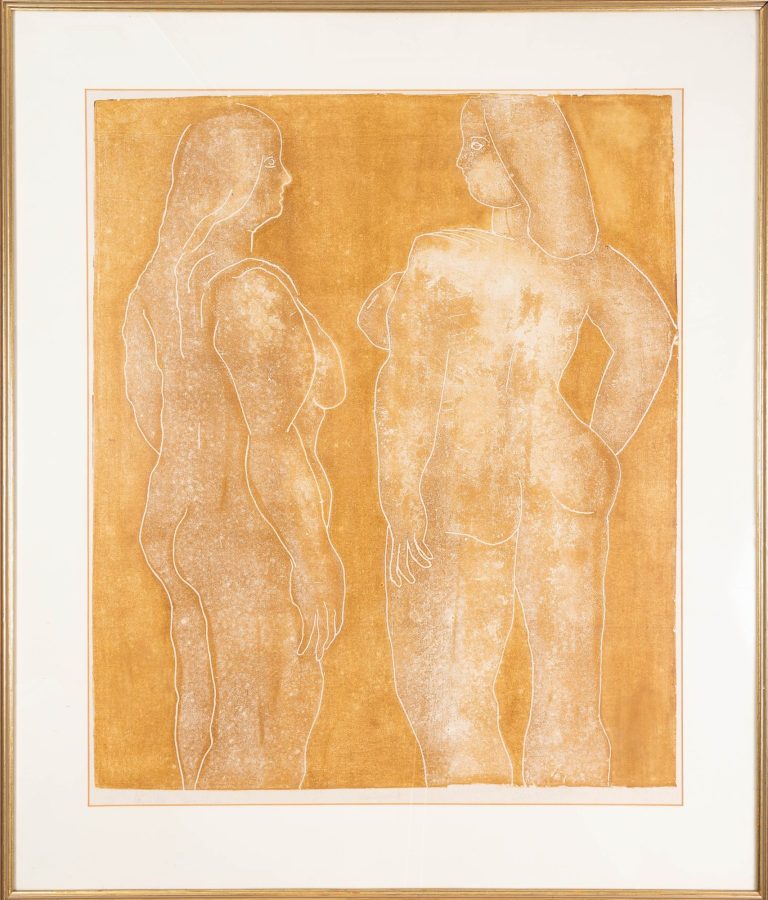
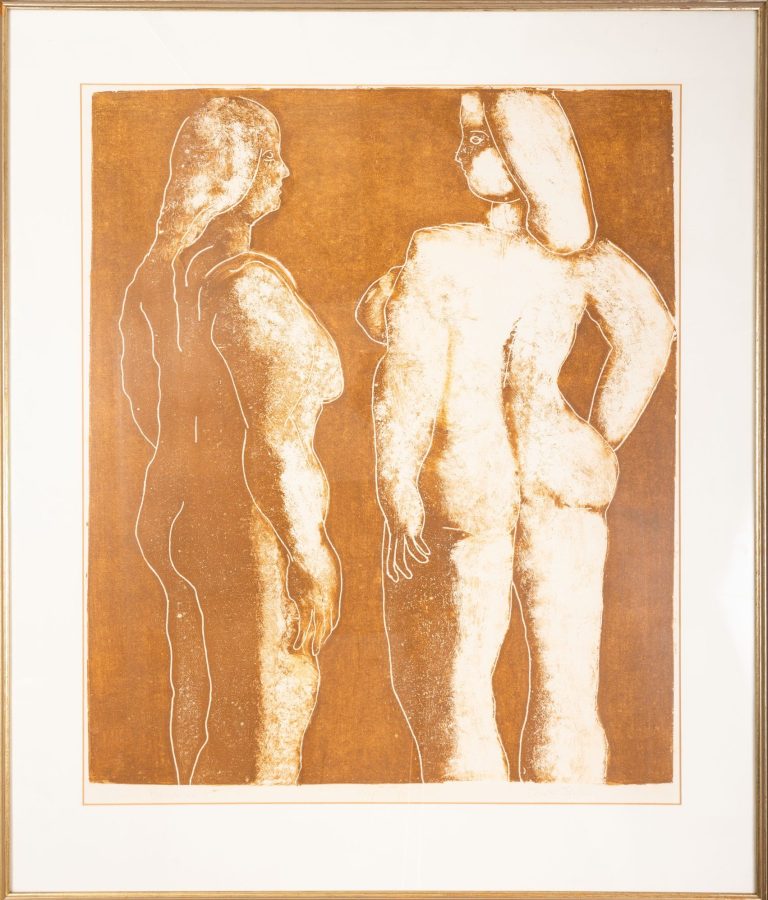
Elstein’s drawings of Christine Grainger also inspired her prints Towards Boadicea and Boadicea II. In these works, the female figures fill the entire frame, their force emphasised by the simplicity of the composition. Grainger had been a shot-putter and in Boadicea II, Elstein has emphasised her strong figure by creating an intense sense of light and shadow.
By titling the work ‘Boadicea’ meaning ‘Victorious Woman’, Elstein conjures images of powerful women throughout history. The choice of yellow ochre ink and the texture of the carved marks almost gives the impression they have been carved into a wall or onto pottery. As though the work could be a historical artefact and the figures have been recorded to tell a narrative.
Elstein had a strong willed, powerful personality and did not enjoy being called a ‘woman artist’. She believed adding the prefix ‘woman’ alluded to the role being less than or different to that of a male artist. Sarah Hyde’s book ‘Exhibiting Gender’ published 1997, features Elstein’s print One with Another (1988) and Howard Hodgkin’s David’s Pool at Night (1985) on the same page. The author asks the reader to guess which print was created by a male or female artist which Elstein believed was a wholly unnecessary exercise. However, whilst working with early career artist-curators in the Cecile Elstein Studio team, Molly Goulding and Emily Uttley, she became aware of new interpretations of being a female artist. For instance, British art historian, Katy Hessel, began her column for The Guardian, ‘The Great Women’s Art Bulletin’ to highlight how female artists had been written out of the canon of art history. Intentionally using the phrase ‘women artists’ to emphasise their gender.
1983
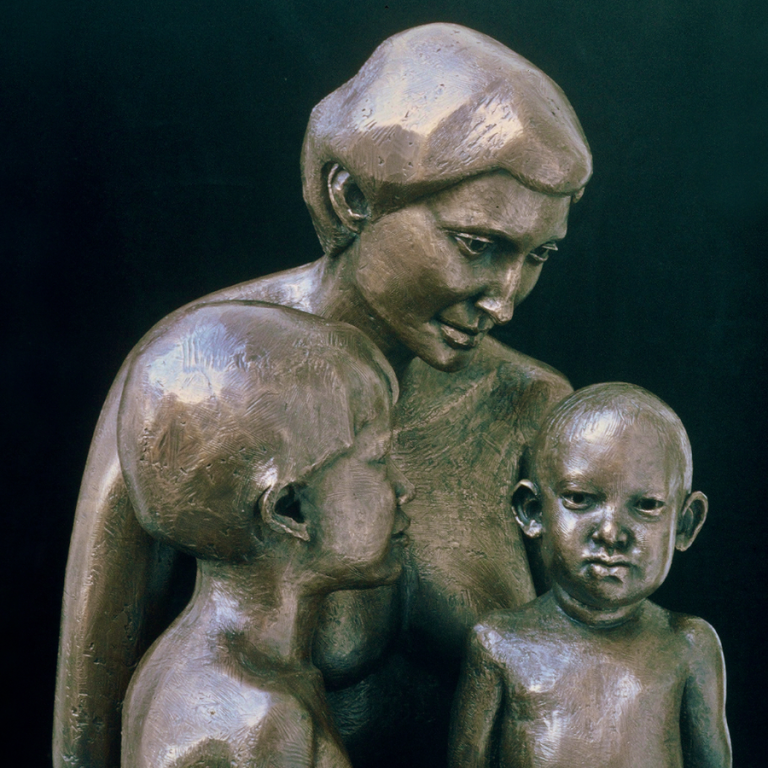
Isobel with Children
The bronze sculpture, Isobel with Children, is a bust of two small children and a female figure. Elstein was commissioned by scientist Isobel Silverman, nee Braidman, to create a work to celebrate the birth of her second child.
The space between the figures is deliberate and considered to represent, Elstein writes, a “contemporary view of family relationships which aim to encourage space for individual personalities and growth”. The female figure’s shoulders are shaped as an arch to provide protection and shelter, without encroaching on the children. Understanding Silverman’s role as a scientist, the female figure is also allowed space for her interests.
Elstein was able to express the children’s personalities by observing them playing in her studio and garden. In conversation with Silverman in 2024, she explained “they were rolling around and out of this activity, I had to make a still item”. Rather than take photographs, Elstein worked straight into the clay from life.
1984
Mother, Child and Little Fish
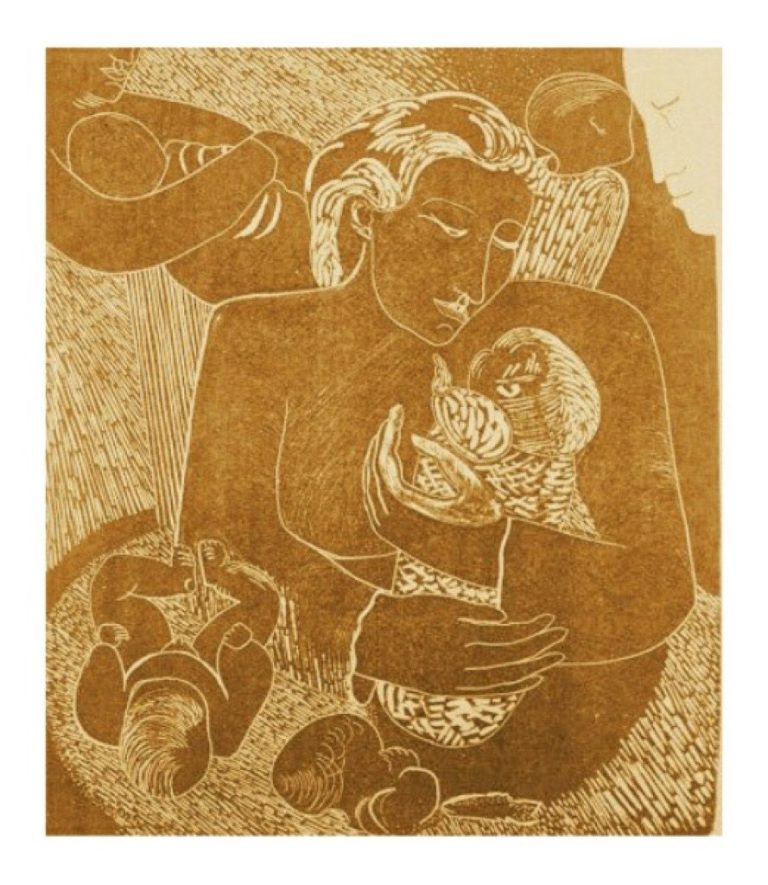
Following the birth of her third child, Silverman commissioned the plasterblock print Mother, Child and Little Fish. To construct the print, Elstein observed Silverman caring for her newborn. She did not stage the mother and baby but watched Silverman go about her day, from feeding time to bath time. Elstein made various sketches and the final composition is a construction of these different moments.
The print consists of five babies and two female figures to emphasise the round the clock care a baby requires. The father, Rabbi Reuven Silverman, is present in the top right-hand corner as witness. The addition of the goldfish symbolises life and prosperity.